_edited.png)
How Solar Power Sparked New Life in the Gobi Desert - Goats and Vegetation
Updated: Apr 14
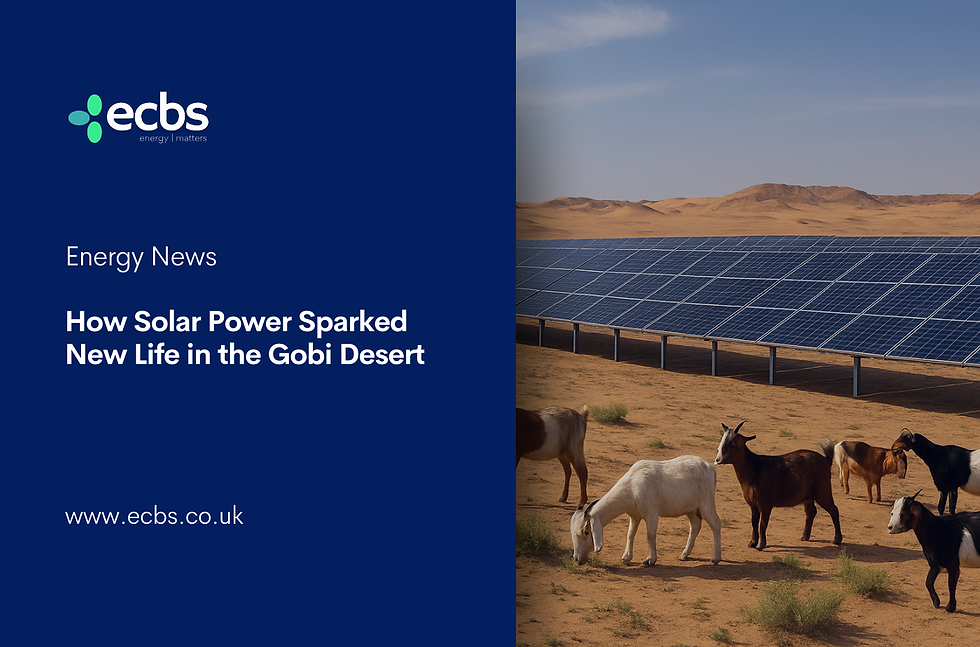
China is home to the world’s largest solar farm, Xinjiang. It spans across 200,000 acres and is roughly the size of the city of New York. The industry leading sustainable energy producing venture has the capacity of 5GW’s and produces over 6.1 million kWh per year - that is enough to provide energy to over 6 million homes annually.
The 235 square miles of PV solar panels are concentrated across west China in the Gobi Desert. Known as one of the driest places on earth, the desert’s harsh conditions provide little resources for life to be sustained. Despite the locations inhospitable nature, the 4000-hour average of sunlight it provides per year creates the perfect conditions for a solar farm to work at maximum potential.
Despite the overall success of the project, building the world’s largest solar farm can come with its challenges. The Gobi Desert has an extremely continental and dry climate. Winters are severe, with temperatures dropping to -40C while summers are scorching, with highs reaching up to 45C. Following the initial build, the extreme conditions mean the PV Panels require constant maintenance.
Xinjiang would constantly become covered in dust and sand, blocking the powerful rays they needed to work at full capacity. China’s engineers devised a unique solution with came with a fascinating by-product.
To combat the build-up of dust, engineers introduced automated cleaning systems designed to sweep and brush the panels without using water, a vital consideration in one of the driest regions on Earth. They also discovered that planting hardy ground cover around the panels reduced sand movement and helped stabilise the soil. As vegetation established itself, it created just enough structure to limit drifting sand.
To manage this growth, engineers introduced herds of goats to naturally graze across the site. The goats kept vegetation at practical levels, fertilised the soil, and helped maintain ground stability around the solar arrays. This simple approach supported a balanced environment beneath and between the panels without requiring machinery or water.
While the Gobi Desert has always been an extreme, barren landscape, these small changes created by shade, soil stabilisation, and controlled grazing have led to pockets of new biological activity. Small plants, insects, and signs of wildlife have begun to appear in areas that previously offered almost no opportunity for life to take hold.
Rather than restoring a past ecosystem, the world’s largest solar farm is supporting new forms of ecological activity in a habitat that has historically been too harsh to sustain them. It demonstrates how large-scale renewable energy projects can influence the environment in unexpected ways, not by changing the desert’s nature, but by creating micro-conditions where life can exist.
The story of this project highlights a broader point: renewable energy can
contribute benefits far beyond power generation. In this case, it shows how thoughtful engineering, natural land management, and a few well-placed goats can help foster new signs of life in one of the most challenging environments on Earth.
Solar Power Gobi Desert Goats


